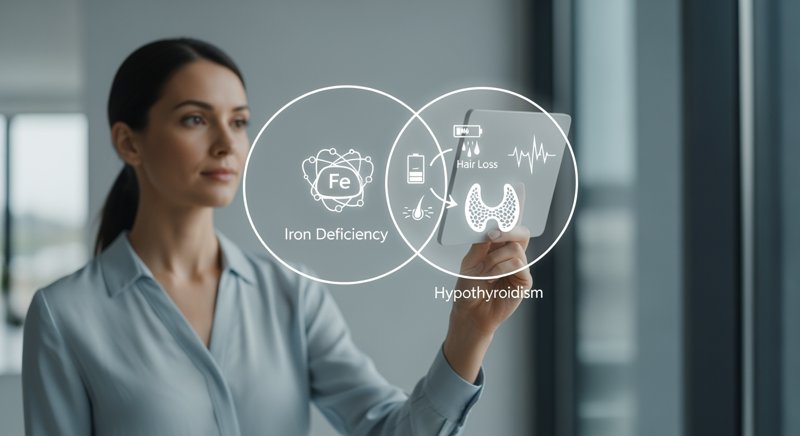
Let’s talk about a state of being that’s all too familiar to many women: a profound, soul-deep fatigue. The kind where you wake up already exhausted. The kind accompanied by a shower drain full of hair and a mood that swings like a pendulum.
Sound familiar? When you’re in this state, you’ve likely heard two armchair diagnoses: “You’re probably anemic!” or “Get your thyroid checked!” The frustrating part is, both could be right. Or wrong.
The problem is that iron deficiency and hypothyroidism (an underactive thyroid) are masters of disguise. Their symptoms overlap so extensively that even a seasoned doctor can’t distinguish them without lab tests. Let’s put these two conditions head-to-head to understand who’s who and what to do about it.
Part 1. The Iron Deficit: Why It’s a Woman’s Story
Nature designed the female body for the incredible feat of creating life, but it comes with a monthly invoice: menstruation. Every period is a loss of iron. Add pregnancy, childbirth, and breastfeeding to the equation, and it’s clear why the female body operates in a constant state of “iron risk.”
Men have it easier. Without regular physiological blood loss, their iron stores are generally stable. For women, ferritin—the protein that stores iron—can be as volatile as a cryptocurrency.
But why is iron so critical?
It’s far more than just “something for your hemoglobin.” Iron is a micronutrient with imperial ambitions.
- The Oxygen Magnate: Its most famous role. As a component of hemoglobin, iron transports oxygen from the lungs to every cell. No iron, and your cells suffocate. This leads to shortness of breath, persistent weakness, and a pale complexion.
- The Energy Director: Iron is a key player in mitochondria, our cellular power plants. Low iron means low energy production. Hello, chronic fatigue.
- The Neurochemical Conductor: Normal synthesis of dopamine (motivation, pleasure) and serotonin (mood, calm) is impossible without iron. A deficiency directly contributes to apathy, irritability, depressive states, and “brain fog.”
- The Builder and Defender: Iron is involved in collagen synthesis and immune function. This explains dry skin, brittle nails, cracks at the corners of the mouth (angular cheilitis), and frequent colds.
The symptoms of iron deficiency are insidious. They build slowly, and you can get used to a state of “half-living,” accepting it as your new normal.
Checklist: Suspecting Iron Deficiency
- Profound weakness and sleepiness: You sleep 8-9 hours but feel like you’ve been hauling freight all night.
- Shortness of breath and palpitations: Even with minimal exertion.
- Pale skin and mucous membranes: Check the inside of your lower eyelid; if it’s pale pink instead of a healthy red, that’s a warning sign.
- Hair loss: Not just a few strands, but noticeable clumps on your pillow and brush.
- Brittle, spoon-shaped, or ridged nails.
- “Brain fog,” difficulty concentrating and poor memory.
- Irritability, tearfulness, apathy.
- Restless legs syndrome: An irresistible urge to move your legs, especially in the evening.
- Pica: Cravings for non-food items like ice, clay, or starch—a near-certain sign of iron deficiency.
If you recognize yourself in three or more of these, it’s time to dig deeper.
Part 2. The Thyroid: Quiet Conductor of Your Metabolism
The thyroid is a small, butterfly-shaped gland in your neck with immense power. Its hormones (T4 and T3) regulate the metabolic rate of your entire body.
When the thyroid’s function slows down (hypothyroidism), your whole system shifts into power-saving mode. Everything slows: your metabolism, your thoughts, your heartbeat. And this is where the great confusion begins.
Checklist: Suspecting Hypothyroidism
- Fatigue, weakness, sleepiness: Yes, again. But hypothyroid fatigue is often described as a more profound, “total” exhaustion.
- Weight gain or inability to lose weight despite a normal diet and exercise.
- Dry skin and hair loss: Hypothyroid hair loss is often diffuse, and can include the outer third of the eyebrows.
- Puffiness (edema): Especially in the face in the morning.
- Cold intolerance: You’re always cold, even when others are comfortable.
- Cognitive slowing, poor memory, “brain fog.”
- Constipation: The digestive system becomes sluggish, too.
- Slow heart rate (bradycardia).
As you can see, “fatigue,” “hair loss,” and “brain fog” are on both lists. So how do you tell them apart?
Part 3. The Vicious Cycle: How Iron and Thyroid Are Linked
Now for the most interesting part. These two conditions don’t just mimic each other—they are biochemically intertwined and can trigger one another in a vicious cycle.
- Iron is essential for thyroid hormone production. Thyroid peroxidase (TPO) — the enzyme that builds thyroid hormone by oxidizing dietary iodide and attaching it to thyroglobulin — is a heme-containing enzyme, meaning its very structure depends on iron (heme is a porphyrin-iron complex). No iron, no heme; no heme, no fully functional TPO. So even when the pituitary keeps signaling the gland (via TSH) to make more hormone, a depleted body lacks the raw material to comply — a state sometimes called tissue-level or secondary hypothyroidism. Clinical research shows iron deficiency can explain persistent symptoms even in patients already taking levothyroxine.
- Thyroid hormones are essential for iron absorption. Hypothyroidism can reduce the production of stomach acid, which is necessary to absorb iron from food.
It’s a feedback loop: iron deficiency impairs thyroid hormone function, and hypothyroidism impairs iron absorption. Breaking this cycle requires precise diagnostics, not guesswork.
Part 4. Lab Detective: What to Test and How to Read It
Self-diagnosis based on symptoms is a dead end. The only way to untangle this knot is with a blood test.
Forget about hemoglobin alone! Anemia is the tip of the iceberg, the final stage of iron deficiency when stores are completely depleted. For months or years before that, you can have latent iron deficiency, where hemoglobin is normal but you feel terrible.
Key Iron Panel Tests:
- Ferritin: This is your iron storage protein. It is the single most important marker. Lab reference ranges often start as low as 10-15 ng/mL, but this is a level for survival, not wellness. For optimal health, a woman’s ferritin level should be at least 40-60 ng/mL, with many functional medicine doctors aiming for a level close to her body weight in kilograms.
- Complete Blood Count (CBC): Look beyond hemoglobin to the red blood cell indices (MCV, MCH, MCHC). They often decrease before hemoglobin drops.
- Serum Iron, TIBC, and Transferrin Saturation: These show how much iron is circulating and how much is ready for transport. A transferrin saturation below 20% is a clear sign of deficiency.
The “normal ferritin” trap. Ferritin has a catch: it is also an acute-phase protein. Any ongoing inflammation — an untreated tooth, chronic tonsillitis, obesity, an autoimmune process — pushes the liver to make more ferritin, which can look reassuringly “normal” (say, 60 ng/mL) while your tissues are still starved of iron. That is why modern protocols interpret ferritin alongside C-reactive protein (CRP): if CRP is elevated, a “normal” ferritin does not rule out iron deficiency.
Key Thyroid Panel Tests:
- TSH (Thyroid-Stimulating Hormone): The most sensitive marker. The brain’s pituitary gland produces TSH to “nudge” the thyroid. If the thyroid is sluggish, TSH levels rise.
- Free T4 and Free T3: The active, unbound thyroid hormones.
- TPO Antibodies: Checks for an autoimmune attack on the thyroid (Hashimoto’s disease), the most common cause of hypothyroidism.
Part 5. The Action Plan: A Smart and Fast Recovery
If your labs confirm iron deficiency, what’s next?
First things first: you cannot fix a significant iron deficiency with diet alone. The idea of curing it with spinach, apples, or pomegranate juice is a myth. These contain non-heme iron, of which your body absorbs only about 5-7%.
The only effective path is iron supplementation, prescribed by a doctor.
- Take it with cofactors. Iron’s best friend is Vitamin C, which can dramatically increase its absorption.
- Avoid its enemies. Calcium (dairy), polyphenols (tea, coffee), and phytates (grains, legumes) block iron absorption. Separate them by at least two hours.
- Be patient. Raising ferritin is a slow process. You might feel better in a few weeks, but replenishing your stores can take 3-6 months of consistent supplementation, with regular monitoring of your lab values.
Oral first, IV when justified. Oral iron — ferrous salts (sulfate, fumarate) or the gentler ferric, chelated, and liposomal forms — is the first-line standard. Ferrous iron absorbs fastest but more often causes nausea, constipation, or stomach pain. If tablets aren’t tolerated or the deficiency is severe, current hematology guidelines support intravenous iron, which can refill the depot in one or two infusions — but only under medical supervision, because of the risks of allergic reaction and iron overload.
If your labs show hypothyroidism, the path leads to an endocrinologist for hormone replacement therapy, a treatment that requires careful medical supervision. And if you end up taking both iron and levothyroxine (T4), never swallow them together: iron binds the hormone in the gut and blocks its absorption. Separate them by at least four hours — levothyroxine first thing in the morning on an empty stomach, iron in the afternoon or evening.
Mini-FAQ
Can I take iron supplements at the same time as levothyroxine (T4)?
Absolutely not. Iron forms insoluble complexes with levothyroxine in the gut and blocks its absorption. Separate thyroid hormone replacement and iron by at least 4 hours — levothyroxine in the morning on an empty stomach, iron in the afternoon or evening.
What ferritin level is optimal for women?
Most lab reference ranges start at 10-15 ng/mL, but trichologists and endocrinologists agree that for healthy hair growth and adequate energy, ferritin should be at least 40-50 ng/mL — ideally roughly equal to your body weight in kilograms, but not above 100-120 ng/mL.
Do vitamin C and folic acid help iron absorption?
Yes. Ascorbic acid (vitamin C) significantly improves non-heme iron absorption by converting it into a more bioavailable form. Folic acid and vitamin B12 are required for healthy red blood cell production overall, which is why they are often co-prescribed in anemia management.
How long do I need to stay on iron supplements?
Treatment is long. After hemoglobin normalizes (usually within 3-4 weeks), iron must be continued for at least another 2-3 months to refill tissue stores (ferritin). The exact duration is set by your physician based on follow-up labs.
Is it safe to schedule iron IV infusions on my own?
No. Hematology guidelines emphasize that intravenous iron carries risks of anaphylaxis and iron overload (hemosiderosis), which is toxic to the liver and heart. Dose calculation and infusion must be performed under medical supervision.
In Conclusion
Chronic fatigue is not a character flaw or a woman’s “lot in life.” It is almost always a biochemical issue that can and should be corrected.
Stop blaming your exhaustion on stress or bad weather. Your body is sending you clear signals. Your task is to listen and decode them correctly. Start with two simple, powerful tests: ferritin and TSH. As of early 2026, many clinicians also recommend checking Vitamin D alongside ferritin and TSH, as deficiency in all three frequently coexists in women with chronic fatigue. This inexpensive check-up can be the first step to reclaiming your energy, mental clarity, and well-being.