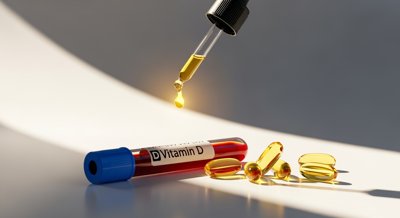
Vitamin D deficiency means the body’s stores of vitamin D — the hormone-like nutrient made in skin exposed to sunlight and absorbed from a few foods — have fallen too low to keep calcium and bone metabolism running normally. It is one of the most common deficiencies worldwide, affecting up to a billion people, and is more frequent in winter, at higher latitudes, and in people with darker skin or little sun exposure. It is confirmed by a single blood test, the 25-hydroxyvitamin D test, read alongside a few supporting markers when the deficiency looks significant. Vitamin D acts less like a vitamin and more like a hormone, governing how much calcium the gut absorbs and how bone is rebuilt, which is why a shortfall shows up first in the skeleton and in vague, whole-body symptoms.
Who is at risk
Sunlight on skin makes most of our vitamin D, so anything that limits it raises risk: living far from the equator, spending most of the day indoors, covering the skin, consistent sunscreen use, and older age, when skin makes vitamin D less efficiently. Darker skin needs longer sun exposure to make the same amount. Other groups at risk include people with obesity, in whom vitamin D is sequestered in fat tissue; those with malabsorption such as celiac disease, Crohn’s disease or after bariatric surgery; people with chronic kidney or liver disease, which impairs vitamin D activation; exclusively breastfed infants; and anyone on medications that speed vitamin D breakdown, such as some anticonvulsants and glucocorticoids. Diet plays a smaller part, since few foods — oily fish, egg yolk, fortified milk — carry much. Levels typically dip in late winter and early spring, after months of weak, low-angle sun have drawn stores down, and recover over summer, so the season in which you are tested colours the result.
Symptoms
Mild deficiency is often symptom-free, discovered only on a blood test. As levels fall further, the classic complaints are aching bones and muscles, muscle weakness — especially difficulty rising from a chair or climbing stairs — and cramps. Many people report persistent fatigue and low energy, low mood that deepens in winter, more frequent colds and infections, and some notice hair thinning. Muscle cramps at night can reflect the low calcium and magnesium that travel with severe deficiency; our guide to the lab tests behind night leg cramps covers that overlap. Because fatigue is so non-specific, vitamin D is one of the seven tests behind constant tiredness. In prolonged, severe deficiency, bone softening — osteomalacia in adults, rickets in children — causes bone pain, tenderness and, in children, bowed legs. Because each of these complaints is mild and easy to blame on a busy life, deficiency is often missed for months, and is frequently uncovered only when a doctor tests for it while investigating tiredness, low mood or aches. The symptoms hub links other complaints to the tests that explain them.
Which lab tests confirm it
The diagnosis rests on one test, with three others used to judge how much the deficiency matters. The test needs no fasting and can be drawn at any time of day, because it measures a storage form that is stable over weeks rather than one that swings with a recent meal or a day in the sun.
- Vitamin D (25-OH) — the definitive test, measuring 25-hydroxyvitamin D, the storage form that reflects both sun-made and dietary vitamin D over recent weeks. Low is the finding. Labs commonly flag deficiency below 20 ng/mL (50 nmol/L) and severe deficiency below 12 ng/mL (30 nmol/L), with 20–29 ng/mL called insufficient and 30 ng/mL (75 nmol/L) or above sufficient. Because reports use ng/mL in the US and nmol/L elsewhere, a unit converter helps you line yours up; note that the 2024 Endocrine Society guideline has moved away from rigid cut-offs.
- Parathyroid hormone (PTH) — rises as vitamin D falls, because the body pushes it up to defend blood calcium. A high PTH with a low 25(OH)D confirms the deficiency is functionally significant, not just a number.
- Magnesium — a cofactor the body needs to activate vitamin D and to release PTH. A low magnesium can keep vitamin D stubbornly low despite supplements, and is worth checking when levels will not rise.
- Alkaline phosphatase (ALP) — the bone-turnover enzyme, which climbs when prolonged deficiency softens bone. A high ALP points to osteomalacia or rickets rather than a mild dip.
Doctors usually add calcium and phosphate, which run low in advanced deficiency, to complete the bone-chemistry picture.
How to read the results together
The single 25(OH)D level tells you the store; the companions tell you the consequence.
- A significant, active deficiency: a low 25(OH)D plus a high PTH plus a high ALP, often with low-normal calcium and low phosphate, is the biochemical signature of osteomalacia — the bones are being affected and correction is more urgent.
- A milder, isolated dip: a low 25(OH)D with a normal PTH and normal calcium usually means insufficiency without major impact on bone chemistry — often corrected with sunlight, diet and a modest supplement.
- The seasonal dip: a mildly low 25(OH)D taken in late winter, with a normal PTH, calcium and ALP, is common and often self-corrects as daylight returns — here the timing of the test matters as much as the number.
- The deficiency that will not budge: a 25(OH)D that stays low despite supplements should prompt a magnesium check, since without magnesium the body cannot activate vitamin D efficiently.
What happens next
Most deficiency is corrected with vitamin D replacement — the specific dose and form are set by your doctor, who tailors them to how low the level is and to any absorption problem — plus sensible sunlight and dietary sources such as oily fish and fortified foods. Sensible sunlight means short, regular time outdoors without burning, and correcting a low magnesium first can be the step that lets levels finally rise. A 25(OH)D is usually rechecked after about 8–12 weeks to confirm the store has refilled, then less often for maintenance. Where deficiency has caused bone symptoms, calcium intake is reviewed at the same time, and stubborn or severe cases may be referred for specialist follow-up. Where an underlying cause such as malabsorption or kidney disease is found, treating that is part of the plan. Do not start high-dose vitamin D on your own: too much can raise calcium to harmful levels.
When to see a doctor
Book a routine appointment for ongoing fatigue, bone or muscle aches, or frequent infections, so vitamin D can be checked alongside the other usual causes rather than assumed. See a doctor sooner if you have bone pain with tenderness, muscle weakness that makes stairs or standing hard, or a fracture from a minor knock, which can signal bone softening. Symptoms of high calcium from over-supplementation — nausea, excessive thirst, frequent urination, confusion — need prompt medical review.