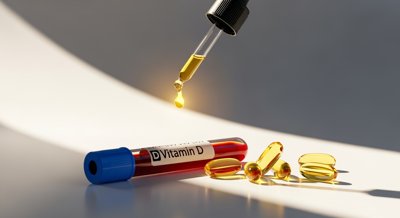
☠️ Vitamin D Overdose: The Dangers of Uncontrolled Supplement Use
Biohacking on the Brink: How a “Vitamin Cocktail” Nearly Sent a Man to the Grave (Clinical Case Breakdown)
We live in an era where taking care of health has turned into a kind of sport, and sometimes—into a religion. The idea that our body is an imperfect machine that needs to be “tweaked” with a handful of dietary supplements has captured the minds of millions. We drink omega for the brain, zinc for immunity, magnesium for calmness, and collagen for eternal youth.
But where is the line between self-care and the toxicology department?
Today, the Wizey AI team is breaking down an instructive, frightening, and absolutely real case published in the authoritative medical journal BMJ Case Reports in 2022 (Alkundi A, et al. BMJ Case Rep 2022;15:e250553). This is a story about how “natural” supplements can strike a blow worse than heavy pharmacology if taken thoughtlessly.
A “Molotov Cocktail” for the Kidneys: Patient History
Imagine a middle-aged man. He has a complicated medical background: in the past—spinal tuberculosis, a removed acoustic neuroma (tumor of the auditory nerve), hydrocephalus (a shunt is installed), and chronic sinusitis. It would seem that with such a set, one needs to blow dust particles off oneself and strictly follow evidence-based medicine.
But the patient decided to go another way. He turned to a “private nutritionist” (note, the report does not say “doctor”, and this is important). The goal was noble—to improve health. The result—hospitalization a month after starting the “wellness regimen”.
The man was admitted to the hospital with complaints that resembled a description of medieval torture more than a side effect of vitamins:
- Uncontrollable vomiting and nausea.
- Severe abdominal pain.
- Leg cramps.
- Ringing in the ears (tinnitus).
- Wild thirst and dry mouth.
- Weight loss of 12.7 kg in three months (state of cachexia).
When doctors asked what he was taking, the list took up half a page. It wasn’t just a course of vitamins, it was a carpet bombing of metabolism.
What Was on the “Menu”?
The patient took more than 20 active substances daily. Here is just a part of this list, from which any clinical pharmacologist will start to have a twitching eye:
- Vitamin D: 150,000 IU (international units) per day.
- For reference: the standard prophylactic dose is 400–2000 IU. Therapeutic doses rarely exceed 10,000–50,000 IU and are prescribed in short courses under the supervision of a doctor. The patient exceeded the norm by 375 times. Daily.
- Vitamin K2: 100 mcg.
- Vitamin C, B9 (folate), B2, B6, B3.
- Omega-3: 4000 mg per day (dose is high, but not fatal).
- Minerals: Selenium, zinc, iodine, boron (in the form of borax powder!), magnesium (in two forms), calcium orotate.
- Other: L-lysine, NAC (acetylcysteine), taurine, glycine, choline, probiotics, glucosamine, chondroitin.
This list looks like a receipt from a sports nutrition store, multiplied by the ambitions of an alchemist. But the main “killer” here was Vitamin D.
Pathophysiology of the Disaster: Why Vitamin D Became Poison
Let’s figure out what happened at the biochemical level. We are used to considering vitamins something harmless. “Well, the excess will just come out with urine,” many think. With Vitamin C, this will work (although there is a risk of kidney stones there too). With Vitamin D—no.
Vitamin D is, in fact, a steroid prohormone. It is fat-soluble. This means two things:
- It accumulates in adipose tissue and the liver. The body cannot quickly get rid of excess.
- It has a powerful systemic effect, regulating calcium-phosphorus metabolism.
Mechanism of Toxicity
The main function of Vitamin D is to help the intestine absorb calcium from food. When the level of Vitamin D skyrockets (our patient had >400 nmol/L with a norm of 50–125 nmol/L), the intestine begins to absorb calcium with manic efficiency. Moreover, Vitamin D begins to stimulate osteoclasts—cells that destroy bone tissue to release calcium into the blood.
As a result, severe hypercalcemia develops.
Our hero’s blood calcium level reached 3.9 mmol/L.
- Norm: 2.2–2.6 mmol/L.
- Level >3.5 mmol/L is considered a hypercalcemic crisis, which poses a direct threat to life.
What Does Excess Calcium Do?
Calcium is not only strong bones. It is an ion that controls the transmission of nerve impulses and muscle contraction. When there is too much of it:
- Kidneys: They try to remove excess calcium but fail. Calcium causes vasoconstriction of the kidneys, dehydration (nephrogenic diabetes insipidus—the body loses water trying to flush out calcium), and direct toxicity to the renal tubules. The patient developed acute kidney injury: creatinine jumped to 166 µmol/L (norm 64–106), and urea to 13.4 mmol/L.
- GI Tract: High calcium blocks the work of the smooth muscles of the intestine and stimulates the production of gastrin. Hence vomiting, pain, constipation, and loss of appetite.
- Brain: Hypercalcemia depresses the nervous system. This manifests as confusion, depression, and in severe cases—coma.
- Heart: Excess calcium disrupts the electrical conductivity of the heart, which can lead to arrhythmias and cardiac arrest (systolic arrest).
The patient, in fact, was slowly turning his blood into a lime solution, destroying kidneys and brain.
Diagnostic Detective and Treatment
General practitioners, to whom the patient first got, worked competently. Seeing catastrophic calcium and renal failure in the tests, they did not treat “poisoning with a pie”, but began to dig deeper.
They excluded cancer (malignant tumors often throw calcium into the blood), sarcoidosis, and hyperparathyroidism. When all these diagnoses fell away, one culprit remained—exogenous intoxication. That is, those very jars from iHerb or the shelves of a nutritionist.
Why Was the Treatment Long?
The patient was hospitalized for 8 days. He was infused with liters of saline (rehydration is the first step in hypercalcemia) and given bisphosphonates—drugs that block the release of calcium from bones.
But here’s the catch: the half-life of Vitamin D is about 2 months. Since it “hid” in the patient’s adipose tissue (although he had little fat left due to weight loss, the depots still worked), toxicity persisted for weeks. Even two months after discharge, his Vitamin D level was still off the scale (>400 nmol/L), although calcium was managed to be returned to the upper limit of normal.
This is a classic example of a cumulative effect. You can’t just “stop drinking” a fat-soluble vitamin and become healthy the next day. Your body will give back what has been accumulated for months.
The Problem of “Polypharmacy” in the World of Supplements
This case is a vivid illustration of the term polypharmacy. Usually, we use this word when elderly people are prescribed 10 different drugs that conflict with each other. But now we are witnessing the flourishing of “nutraceutical polypharmacy”.
In the BMJ report, the authors rightly note: data on the toxicity of supplements are limited because people rarely admit to doctors exactly what they drink. And the supplement market is regulated much more weakly than the drug market.
Pay attention to the composition of the patient’s cocktail. There was not only Vitamin D. There was calcium orotate. That is, the person took gigantic doses of a substance that enhances calcium absorption (Vit. D), and at the same time threw in calcium itself. It’s like pouring gasoline on a fire.
There was borax powder. Sodium tetraborate. Yes, in some alternative currents it is used, but in official medicine, its toxicity outweighs the dubious benefit.
There was iodine without checking the function of the thyroid gland (although, fortunately, the patient’s TSH remained normal).
How Not to Become a Hero of a Medical Article?
We at the Wizey AI team constantly say: your body is a complex biochemical laboratory. You can’t just pour reagents into it and wait for a miracle.
Here are a few conclusions that we must draw from this story:
1. Dose Matters (and It Is Individual)
Vitamin D is great. Vitamin D deficiency is bad. But 150,000 IU per day is madness. Prophylactic doses are safe, therapeutic ones are prescribed by a doctor based on a blood test. Not a nutritionist from Instagram, not a neighbor, but a doctor who bears responsibility.
2. Fat-Soluble Vitamins Are a Zone of Special Risk
Remember the quartet: A, D, E, K. These vitamins accumulate. Overdose with them is real and dangerous. Water-soluble (B, C) forgive more mistakes, but even with them, you can play until kidney stones or neuropathy (as with B6 overdose).
3. Tests Are Your Only Navigator
The patient from the article began taking supplements before the onset of symptoms, but, apparently, without a preliminary deep examination. If you decided to “hack” your body:
- Donate blood BEFORE starting the intake.
- Donate blood A MONTH AFTER the start to see the dynamics.
That is why we created Wizey AI. You upload test results, and the system helps you see deviations, dynamics, and possible risks. If this patient had uploaded his tests to our system at the stage of the appearance of the first nausea, the algorithms would have instantly highlighted the critical level of calcium and creatinine, recommending urgent contact with a nephrologist or endocrinologist.
4. Be Careful with “Author’s Cocktails”
If you are prescribed 20 drugs at the same time, this is a reason for serious doubt. The interaction of such a number of substances inside the stomach and blood is unpredictable. No one has conducted clinical trials on how L-lysine, borax, 150k Vitamin D, and Wobenzym work together. You become a volunteer in an uncontrolled experiment.
Summary
The story from BMJ is not a call to give up vitamins. It is a call to common sense.
Hypervitaminosis D is a rare condition, but, as we see, accurate. It hits the kidneys, bones, and brain. Recovery can take months.
Please be critical. Medicine is a science of evidence, not faith in miraculous powders. If you feel bad while taking “wellness” products, this is not a “cleansing” and not an “exacerbation before healing”. This is your body screaming for help.
Listen to it. And check the indicators. As of 2026, poison control centers continue to report a year-over-year increase in Vitamin D toxicity cases linked to high-dose supplements purchased without medical oversight.
Take care of yourself and your kidneys, The Wizey AI Team.