AI in Medicine: How It Actually Works in 2026 (Why It Won’t Replace Doctors, and How to Use It Safely)
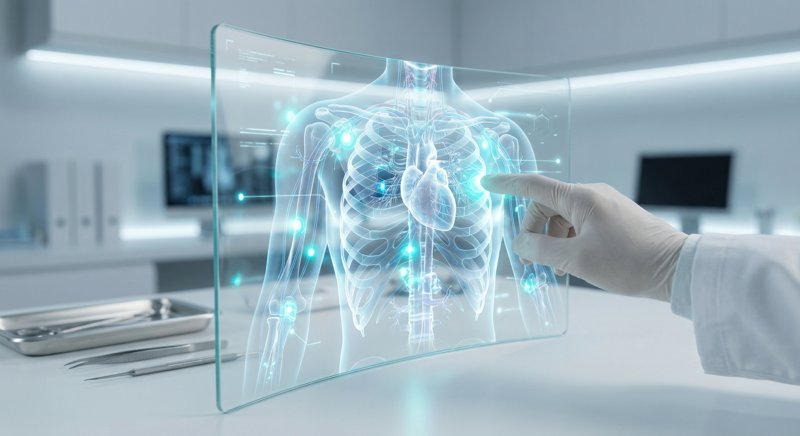
AI in Medicine: How It Actually Works in 2026 (Why It Won’t Replace Doctors, and How to Use It Safely)
Let’s be blunt. When you hear “AI in medicine,” what pops into your head? Either a futuristic scene where a robot performs heart surgery—or the opposite: “AI? I can’t even get a primary care appointment on time.”
Inside the Wizey team, we see how this works behind the scenes. And the reality of 2026—like most real science—is more interesting than the fantasies.
We’re no longer in the “hype” phase where people fed neural networks anything and everything. We’re in the pragmatics phase.
Right now, while you’re reading this, algorithms around the world are already reviewing millions of CT scans, finding hidden relationships in blood tests, and helping clinicians survive the administrative overload.
But there’s a catch: AI is a powerful tool—and you need to use it correctly. Give a microscope to someone who only knows how to hammer nails, and they’ll hammer a nail… and break the microscope.
Today I’ll explain how medical AI actually works in our context, where marketing ends and genuine benefit starts, and how to use these technologies so they help you instead of harming you.
What medical AI is (in plain language, no magic)
Forget the “electronic brain” that thinks like Dr. House. It doesn’t exist.
Medical AI is basically statistics on steroids: complex mathematical models trained on massive datasets. Imagine a skilled physician reviewing 100,000 blood panels over a career. A neural network can “see” 100 million in a night.
It doesn’t “understand” pain or inflammation like a human. But it does recognize patterns.
- A human sees: hemoglobin slightly below normal.
- An algorithm sees: low-normal hemoglobin + changed MCV + hair loss reported in the intake form = 94% probability of iron deficiency, even if ferritin hasn’t been tested yet.
That’s exactly the approach we use: finding non-obvious relationships between lab numbers and how you feel, based on clinical guidance and validated protocols.
Why this works globally (often better than you’d expect)
It’s fashionable to criticize healthcare systems everywhere, but in digital health, the last few years have produced something real: scalable infrastructure + standardized data pipelines + enough compute to make clinical tools usable.
Here are three areas where algorithms already work for you—even if you don’t notice:
- Computer vision. In many countries, CT, MRI, and chest imaging increasingly goes through an AI “first pass.” The model highlights suspicious zones; the radiologist doesn’t waste time on clean scans and focuses on pathology. That reduces the chance of missing subtle pneumonia, early cancer, or tiny hemorrhages.
- Predictive analytics. Systems analyze electronic medical records. If a patient’s glucose has been slowly rising for years (still “normal”), the system can flag a prediabetes risk. Humans often miss slow trends over long time windows.
- Patient-facing services (like Wizey). Tools that translate “medical” into “human,” so you come to the doctor prepared instead of confused.
When AI is a lifesaver—and when it’s a risk
The biggest problem today is the availability of “everyday” AI. People google symptoms or ask a generic chatbot: “My side hurts—what should I take?”
That’s a dangerous mistake.
General-purpose language models (LLMs) are text generators. Their job is to produce plausible-sounding language. If the model doesn’t know an answer, it may invent one—a phenomenon known as hallucination.
In medicine, the cost of a hallucination is your health.
How to tell a useful tool from a harmful one
| Good medical AI (specialized) | Bad option (general AI / random Google) |
|---|---|
| Trained on medical sources: clinical guidelines, verified datasets. | Trained on the whole internet: forums, blogs, Wikipedia. |
| Explains logic: “Marker X is high, and combined with Y it may suggest Z.” | Diagnoses boldly: “You have cancer, drink baking soda.” |
| Knows its limits: “This is complex—see a clinician urgently.” | Confidently wrong: gives treatment advice without uncertainty. |
| Example: Wizey, clinical decision support tools. | Example: forums and generic chatbots. |
If your labs look “bad”: a step-by-step plan
Picture the classic scenario. Evening. You get an email from the lab. You open the PDF and see a “red zone.” Half the markers are flagged high or low. Panic. Worst-case scenarios. Your doctor appointment is a week away.
Here’s what a competent person should do in 2026:
Step 1) Exhale—and close Google
Google will give you cancer for almost any query, from a runny nose to heel pain. That’s how search incentives work: the scariest headlines get clicked. Don’t feed that loop.
Step 2) Upload your data to a specialized analyzer
Use Wizey. Upload the lab report. The system performs a first-pass screening:
- filters out minor deviations (e.g., mildly elevated WBC after eating can be physiologic),
- groups meaningful abnormalities,
- suggests possible causes—and most importantly, urgency.
Step 3) Understand the context
AI can highlight: “This marker can be elevated due to the vitamins you reported, or due to a recent cold.” You’ll see that you’re not “dying” by default.
Step 4) Prepare for the appointment
Instead of showing up with “Doctor, I feel bad, here are some papers,” you arrive with structure.
- “The service flagged my ALT/AST ratio. Could this relate to antibiotics I took a month ago?”
- “My ferritin is low, but hemoglobin is normal. Should we check iron deficiency?”
Doctors don’t treat you like a hypochondriac when you speak in data and questions. It saves appointment time and improves diagnostic accuracy.
Common myths (time to clean up the noise)
There’s so much noise around AI that it’s time to separate myth from reality.
Myth 1: “AI will replace doctors, and robots will treat us”
Reality: AI will replace doctors who don’t use AI. Medicine isn’t only data analysis. It’s empathy, physical exam, tactile information, clinical intuition—and legal responsibility. No algorithm takes responsibility for your life. AI is “a second opinion,” and the final decision stays with a licensed human.
Myth 2: “If AI found nothing, I’m perfectly healthy”
Reality: Labs are just a snapshot of biochemistry. If your stomach hurts and your labs are perfect, the problem can still be real—it just isn’t reflected in blood markers. AI sees numbers, not you. Never ignore physical symptoms.
Myth 3: “My medical data will get stolen”
Reality: Serious products de-identify data. The system sees a set of numbers: “male, 35, glucose 6.5.” It doesn’t see a name and address. Medical data is protected with standards close to banking-grade security.
Mini‑FAQ
Q: Can Wizey diagnose me? A: Absolutely not. We provide interpretation and highlight likely conditions. “Diagnosis” is a legal term—it can only be made by a licensed clinician.
Q: Why do I need AI if I have a doctor? A: Doctors are time-limited (often 10–15 minutes). They may not have time to analyze years of trends or spot rare correlations. AI does the “draft analytics” in seconds, giving the doctor a structured summary.
Q: How accurate are your algorithms? A: We use models trained on verified medical data. For pattern recognition tasks (like anemia or thyroid issues), accuracy can exceed 95%, but we always recommend confirming conclusions with a clinician.
Conclusion
We live in a remarkable time. Medicine is becoming more transparent. In the past, patients were passive recipients who didn’t understand their own lab reports. Today you have tools to understand your body.
AI in medicine is not a replacement for a doctor. It’s your personal translator from “what the numbers say” into plain language. It helps you avoid missing something important—and avoid panicking over noise. As the technology matures through 2026, expect tighter regulatory frameworks and even better accuracy — but the doctor-patient relationship will remain irreplaceable.
If you have fresh (or old) labs and want to understand what they actually mean, don’t guess.
Upload your results to Wizey. Let technology organize the signals, find hidden relationships, and help you show up ready for a constructive conversation with your clinician.